I had the opportunity to work with Hayley Berman from Art Therapy as a tangential workshop to the Fine Art postgraduate course on the 25th November 2019. The aim of the workshop was to ‘explore a visual research method “role consultation analysis”in thinking about an area of practice. This involves working in small groups, reflecting and image making. It could be about thinking together about their body of work, direction for the year …thesis topic..'(Andrews, K 2019 Message to Culverhouse, T. 20 November 2019)
We worked in groups of three in what Hayley called a role consultation set, a method based on hearing, being heard, and being witnessed.
We were invited to explore what we were researching or where we are at in our practice, through an ‘adapted method of image making process’ (Berman, H, during conversation in Studio 25 November 2019). The instructions were to think, and feel about what you want to be researching. Hayley described this as heuristic research. We would then present to the group for feedback and input. The process was to talk for a few minutes presenting the drawing, the group not being allowed to interact, then turning away from the other members, whilst they discussed the drawing without you being able to react or interrupt, just listen. With the rules set, I actively engaged thought and feeling about my practice and made the resulting drawing below.
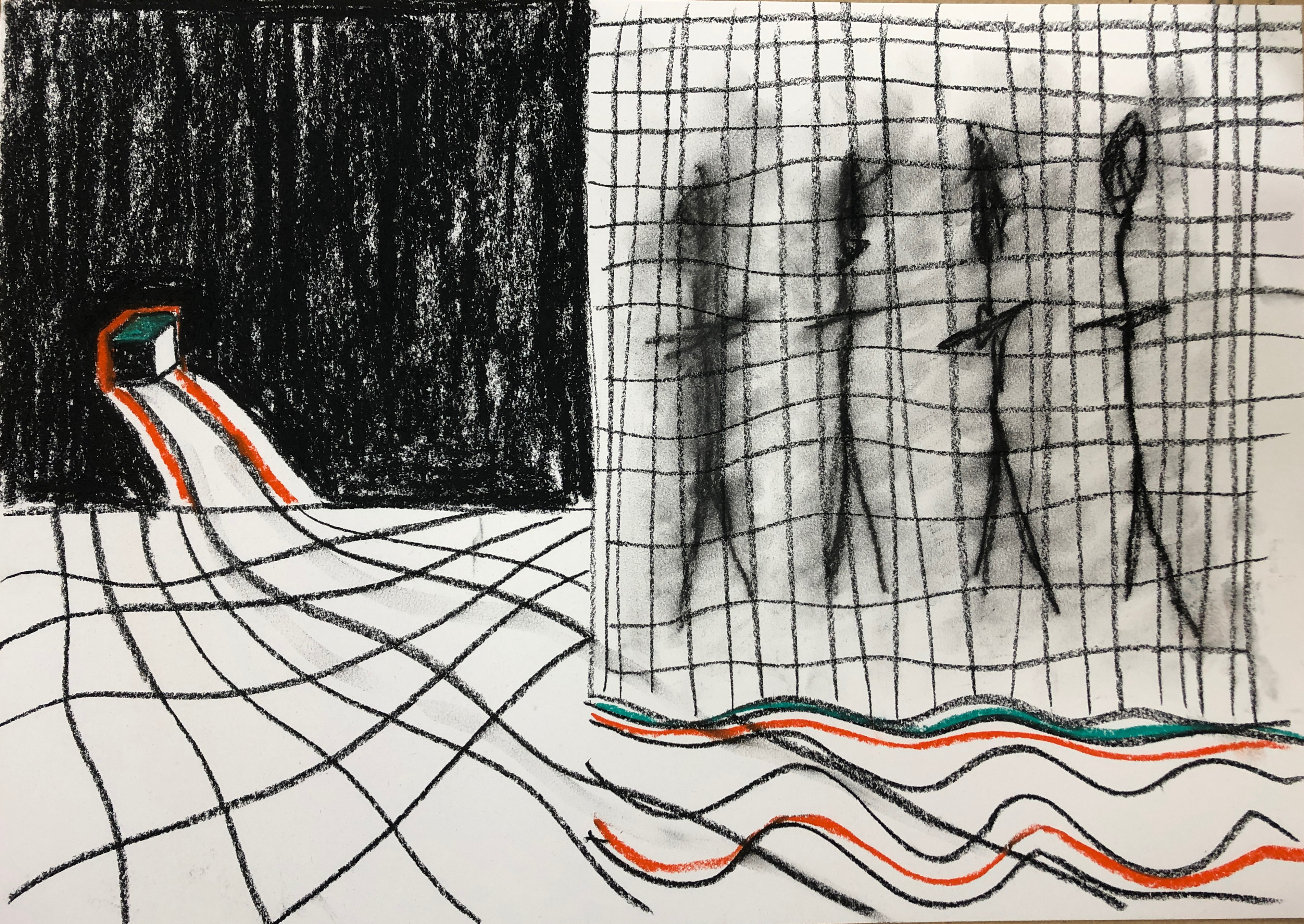
Fig 1 CULVERHOUSE, T (2019) Drawing made during Art Therapy session. University of Hertfordshire, 25 November 2019
I then presented and when I had finished, turned my chair and listened to and made the following notes on what my group said about the drawing in italics:
Contrast in colour and diagonal in life – a definite black area of past.
Because of the contained, border around it (box) its claustrophobic, about a voice being heard, she didn’t have her voice heard as a child, she held a lot back.
The grid – I see those lines as controlled, the figures – she doesnt’ know if these are for different parts of herself or her own family.
There are two things going on there – whether it’s the control – very controlled grid – so its like a curtain – something solid rather than thin film. I see an amazing river – its same colours(as the box) so that energy is still here, it’s a river its got purpose. This hard edge junction is a block that needs to go, be got over in order to swim in the river.
Is this a choice? Is it a safe place? No its a no-mans land – that explains the confusion. Which direction do I go in?
There is a real sense that the river has a flow, a powerful undercurrent. She needs to print and draw and needs to do this art, but she has to navigate this junction – knowing that junction from the box to the river she can navigate it more freely.
I disagree its the past that’s holding her back – I want to flick this cube off the past so it can flow into the river – there is a strong undercurrent pulling this box to come down the river.
I think she knows she is going to be able to forget the past and release it. The colours are there and will flow down the river.
Times bell rings. We then changed roles and repeated this process for all three members of the group.
When the group process was completed by all three members of the group, Hayley went on to discuss that the theory behind this was from Wilfred Bion, she said his method was ‘creating spaces to think with’ (Berman, H, during conversation in Studio 25 November 2019) and it was about a relationship formed in coming together to think about the way things develop. We often work in isolation and its good to come together to share. What was really fascinating about the process here is that as fine artists we do come together often to discuss and share. By being engaged in this small group work assisted by Hayley Berman, in this methodical way enabled listening and thinking on a different level. Not being able to interrupt whilst someone describes us isn’t easy, but it certainly was beneficial.
In the following days I had a bit of a breakthrough when, researching into Bion further, was really excited to find that the trail led me to the book by Anne Reiner, Bion and Being : Passion and the Creative Mind. Reading some points in this, the research led me back to the question I had posed in my Practice One proposal of the numinous, the truth in what how we make contact with the subconscious. I found a statement that Bion was touching upon in artistic terms, for the artist working with these realms of practice, that ‘These new truths derived from contact with that numinous realm encounter harsh resistance.’1 (Reiner, 2014, p.33). Delving deeper into the references in this book led me to a well thumbed page in a book in my own collection which fell open revealing the art master, Matisse’s words ‘There is an inherent truth which must be disengaged from the outward appearance of the object to be represented. This is the only truth that matters.’2 (Read, 1974, p.44). These are words I had read when first researching my own methodology, aged seventeen, and questions on this page about Matisse’s work and practice had fascinated me then. I had come full circle in my research to that which I seek in my practice, the truth of the object, the subject and of the work.
Upon reflection, I think this goes some way to prove that although new ideas and methodologies are always being researched, some are constant, timeless questions artists ask themselves at every point in their practice. This question is one of those fundamental ones that you almost have to forget, rediscover and work on to remove the blocks in creativity. Read knew that Matisse had grappled with this and even some nearly fifty years later this has come out personally for me in this critical thinking through this art therapy process tangential to my practice but very important to discovering the truth to my practice.
Fig 1 CULVERHOUSE, T. (2019) Drawing made during Art Therapy session. University of Hertfordshire, 25 November 2019
1 REINER, A. (2012) Bion and Being : Passion and the Creative Mind. London: Routledge.
2 READ, H. (1974) A Concise History of Modern Painting. London: Thames and Hudson.
 Tina Culverhouse