I have been reviewing my work following my progress crit. I have come up with some rough ideas about what I think the tentative direction my practice is taking within the context of the postgraduate study course.
I have been making conceptual explorations and realise some of the following:
There is a fluid and ambiguous relationship between my making and the meaning.
I am evolving from the “doing” of an idea into the “becoming” of the artwork, from the subjective to the objective. I am doing the opposite of the Hansel and Gretel leaving breadcrumbs, a trail of my ego, my artwork, rather I am picking up and adopting objects into my artwork, a making from being.
In my work I use found objects, drawings, paintings in the form of actual objects, ritualistically collected along my travel path. Walking is for me an important daily ritual and I have to do it for my own survival both as a human and as an artist. I have a ritual of picking up items that I tread on, come across and sometimes this can be not just an object but an image of a happening or an image of a pause or moment in time that I feel I cannot leave behind. I was asked today “why do you pick up these items?” and I responded with “I don’t know, I’ve done it since childhood”, then Maria Meyer questioned me further “but if you had to give a reason, what would that be?”. I knew the answer actually and this answer came very naturally. I have been collecting these treasures since childhood.
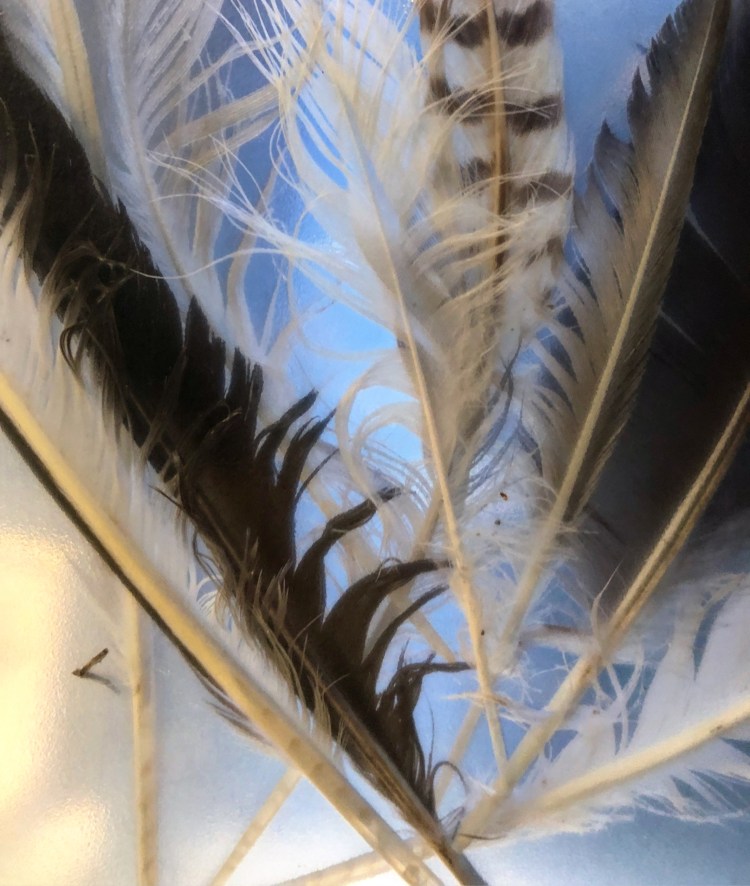
Fig 1 Part of my ritual collection of feathers gathered during a month long writing ritual. The rule was to pick up any item I actually walked onto in my path. I have used this in photograms and cyanotypes as an experimental starting point to make new work.
The work is generated from a need to feel that I exist in this world, that I belong. Picking up these objects, the reversal of discarding, gives me a sense of existence in this landscape I am traveling through. The influence over this environment in collecting these pieces of detritus gives a sense of existence to physically hold. I have utilised some of these gathered objects in a cyanotype and these objects were all feathers, from different birds found during my month long art ritual and since. I wanted to group these feathers together as they felt like a group. A question which arose from the crit was what made me choose these feathers above other objects? I guess I thought they made some kind of sense together dynamically and visually they worked figuratively together. However, as a group from my ritual collection they definitely work, but as it then looked like I had chosen the feathers because of how they worked aesthetically better perhaps then that other objects.
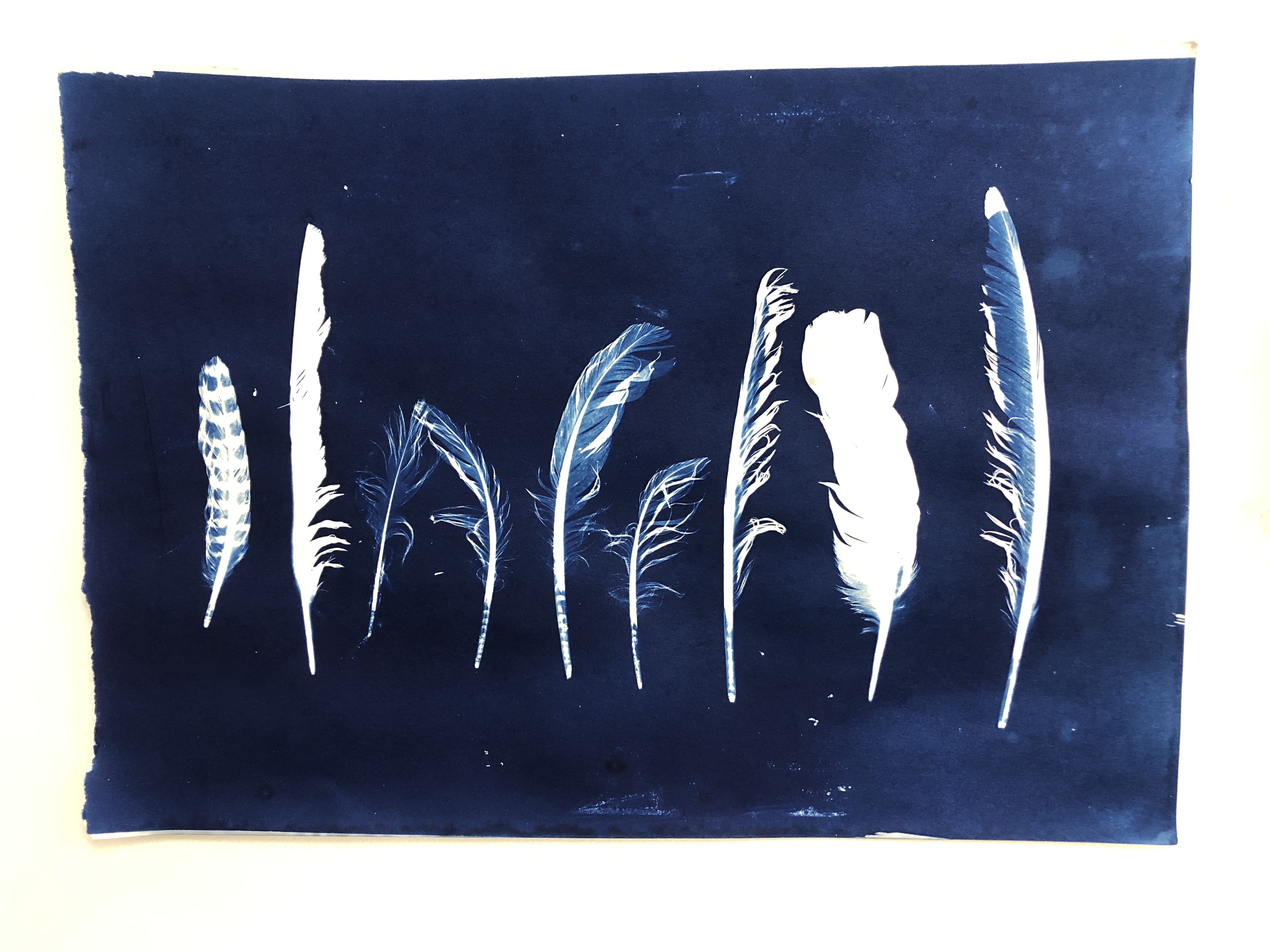
Fig 1 Cyanotype (Culverhouse, T 2019)
Had I made a conscious choice of beauty over less attractive content? I feel the answer is no, my work is not being about beauty per se. This work is about the truth in the objects and the truth within the ritual, collecting what feels right, at that point and important to pick up, photograph, draw. So this collection of objects, photographs and drawings puts me in the subjective and them in the objective.
I have found a book by Kate Nesin, Cy Twombly’s Things (2014). Like Louise Nevelson, who collected from the streets around her as they were being dismantled, Twombly also made collage and sculptures as well has his better known paintings. Both artists from different backgrounds and methodologies working similarly to my practice. In this book Nesin talks about Twombly’s repeating and returning to sculpture and theme she discusses with Twombly’s work making multiples isn’t simply repetition, but he also returns, sometimes to a sculpture 17 years later. ‘”True” or real return is often impossible, after all , a cognisance that meaningfully loads Twombly’s repetitions rather than hollows them out. To make something again, the work posits, is perhaps the only way to make something new, leaving originality out of it.’ (Nesin, 2014, p193)
I have reflected on this all of the work I am making in the darkroom at present, trying to understand how this fits into my wider practice and how I can research this further with how they fit into my wider methodology. Many artists collect objects they feel have agency which inform their practice. Artists like Cy Twombly with his lesser known sculpture using found objects, cast and painted, make me look at my collections with fresh eyes, mine seem more ephemeral; discarded feathers, leaves and wrappers from my lived environment. The research is leading me to discover how to more concretely place these within the studio and my practice.
Nesin, K (2014) Cy Twombly’s Things. London: Yale University Press
 Tina Culverhouse