On the postgraduate cohort there are two photographers, Victoria Leighton and Josiah Lyngwa. I have used photography in my work to a greater extent and asked if I could join this first project.
The Project Outline
To make a formal self portrait piece of work using the self in a way that was not just a gratuitous self portrait and think about post-production. This in itself if outside of my comfort zone having not used the person in any of my work except as a protagonist in installation.
Dave Willis gave a seminar in photography composition, looking at how it could be used to create more dynamic compositions and interest that could be unexpected. He gave lots of examples including how Ansel Adams had used symmetry in his architectural photography to portray power and Lee Friedlander took action shots that seemed impossible and frames within frames and used a shallow depth of field.
Researching Photography
I concentrated on photography in the latter half of my undergraduate degree with my tutor Tansy Spinks teaching me so extensively photography to express movement with many SLR techniques, long exposure and darkroom techniques. I have recently retrained in SLR and bought a 35mm manual camera to try to push my practice and discipline rather than rely on the iPhone camera I find very useful but rely heavily on.
I followed up with researching finding this Lee Friedlander picture from his Mannequin series shown below. In my work, I look at subjects with reflections and unexpected outcomes so this referred back to my own work.

Fig 1. plate 79 of the book under review (Friedlander, 2011)
Dave had told us about thirds within the frame and how to use the thirds to create a more dynamic shot by breaking rules. We discussed Primary colours of transmitted light and how the Green/Red/Yellow could be used in colour photography to great effect. We studied Andreas Gursky and how he uses leading lines, negative space, pattern and colour. In my research later I found the Parliament 1998 (Gursky, 1999) from the Tate online, which I found really interesting as he used the sorts of reflections and colours, again I like to use in my own work.

Fig 2. Parliament 1998 (Gursky, 1999)
Dave had talked about the decisive moment and how often this can cause the dynamic to break rules and be unexpected.
With self portrait in particular I looked further into Sally Mann’s series of self portraits following her accident on her horse which left her unable to work for some time. She took portraits of her self and these are very moving images of her immediate trauma and her relationship to this through photography. The images are haunting and are clearly showing her pain in the glimpses you see of her eyes. I have used the self in portraits in my spirit series work but had found this quite a disturbing and wondered how Mann had felt making these images so public.
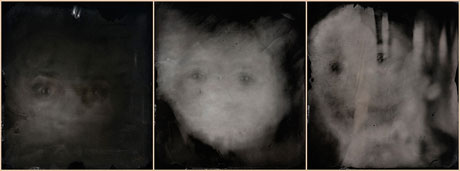
Fig 3 Untitled (Self Portrait) (Mann, 2006-12)
Making the work
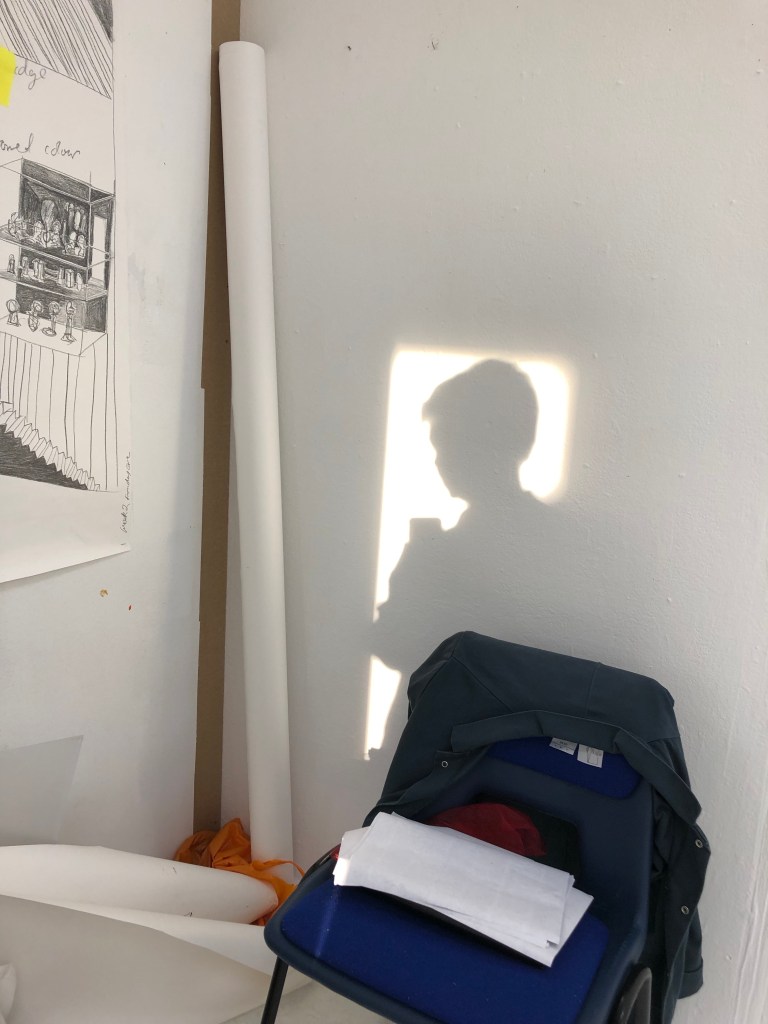
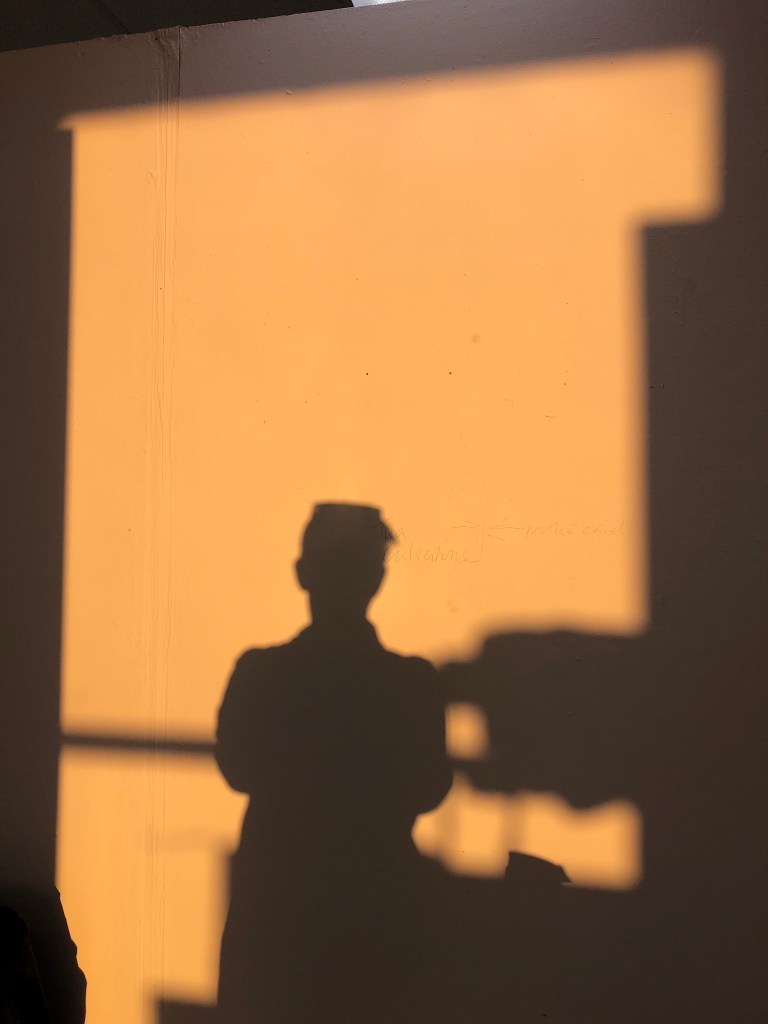
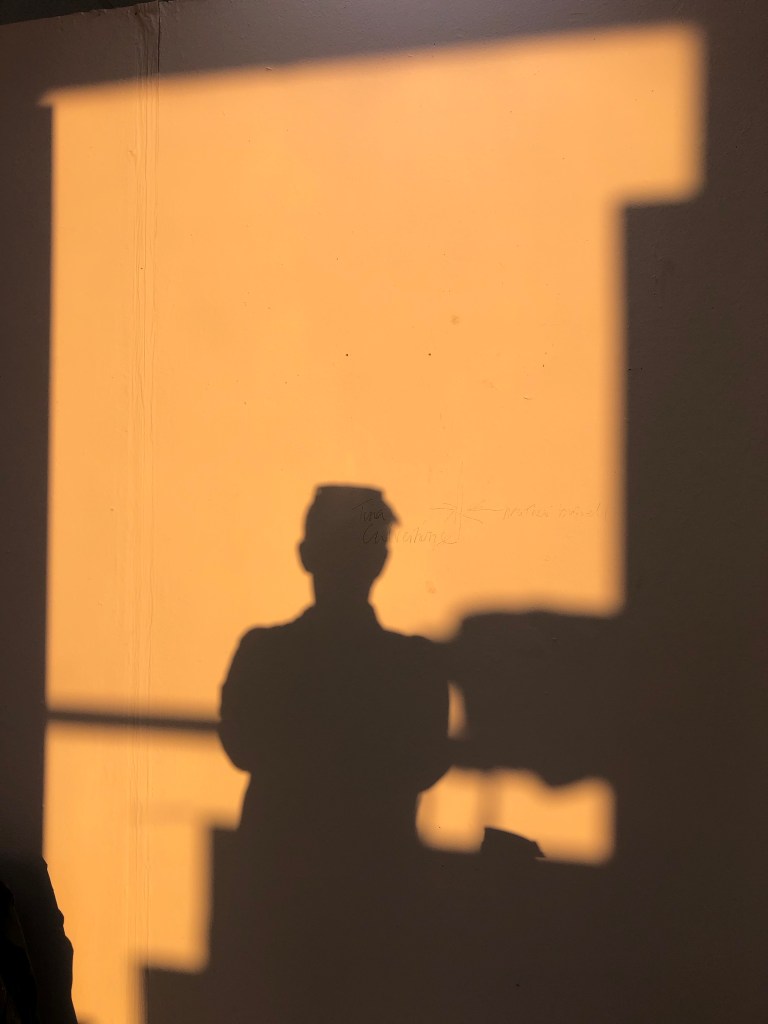
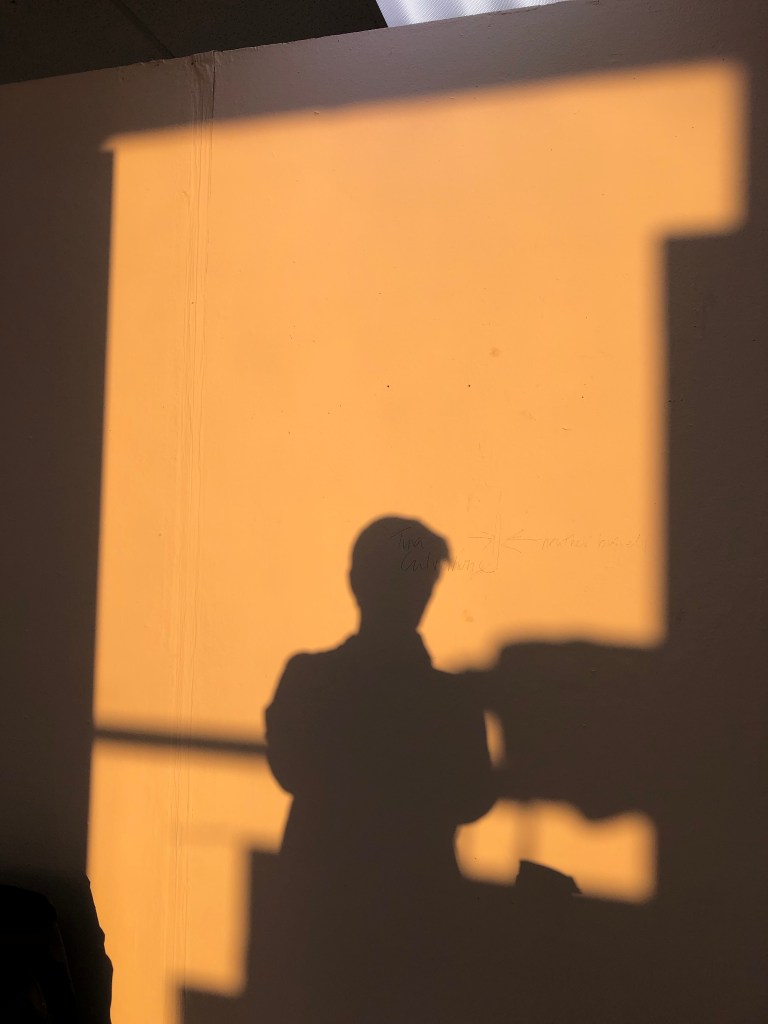
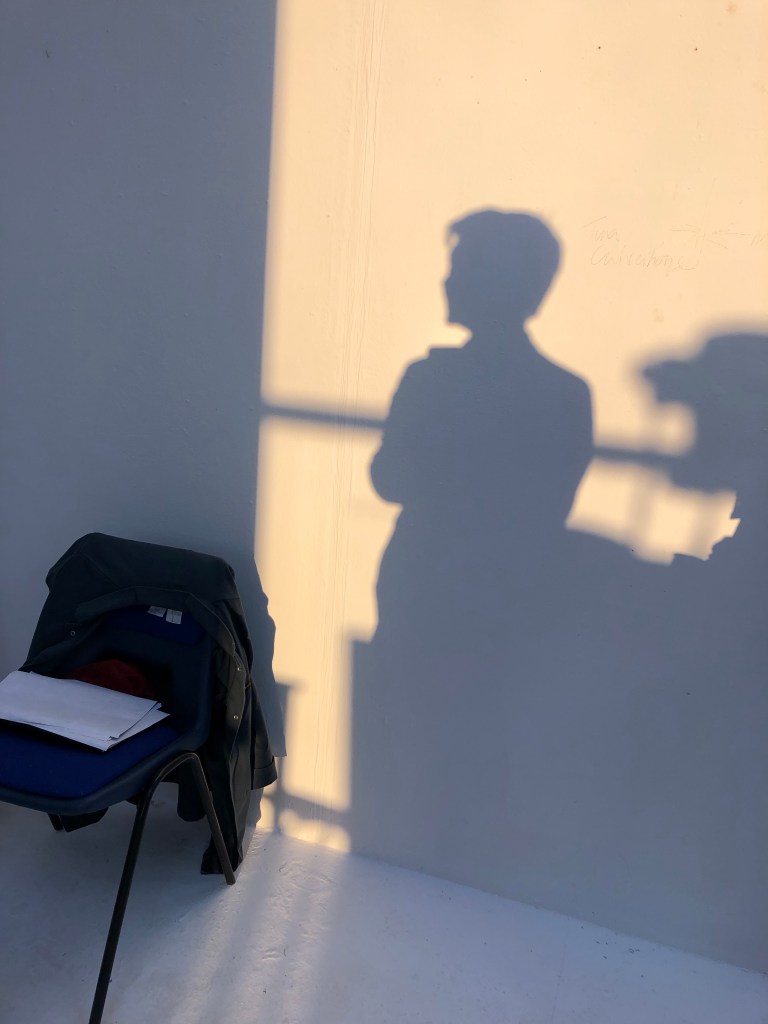
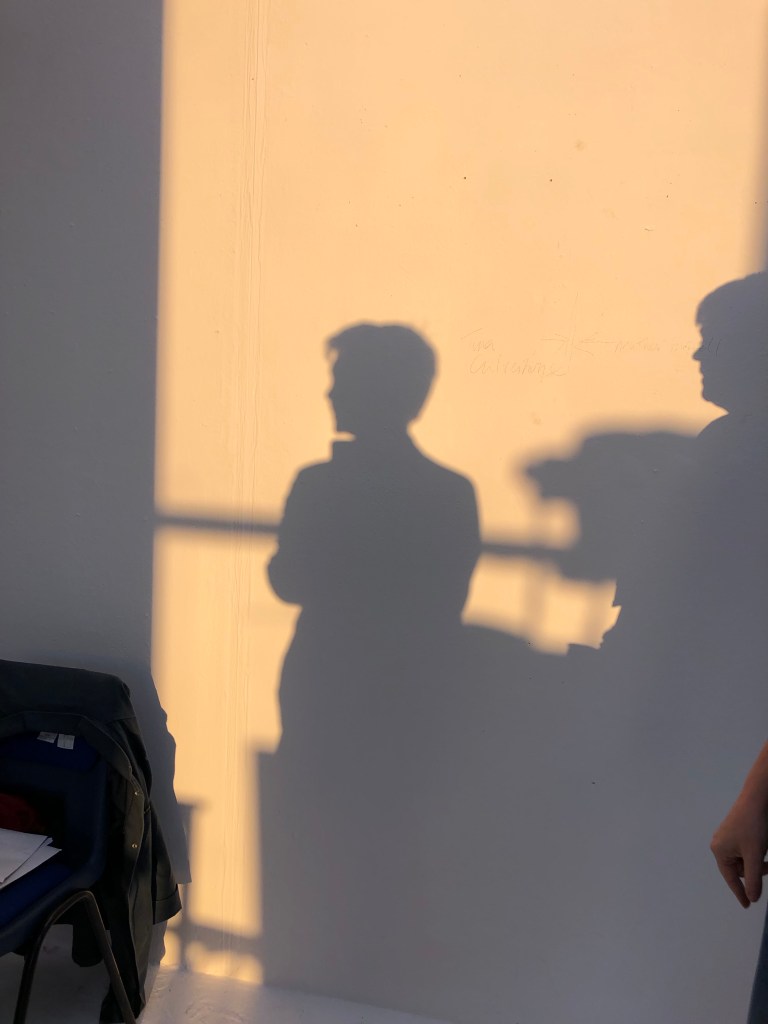
Having already explored my studio space I thought that using the evening light into the space might be a good starting point. I liked my chair with my work jacket on it, as a describer of my being an artist and it invoking some of my personality. I placed it within the space and the light was good to take a shadow portrait. As the light changed I used this change in hue and tone until the light was finally in full sunset and golden. I was working around others in the studio so needed to wait for the right shots. I was also carrying on with making my work too and a series of work with found objects and the shadows cast in preparation for planning some darkroom photograms.
The outcome
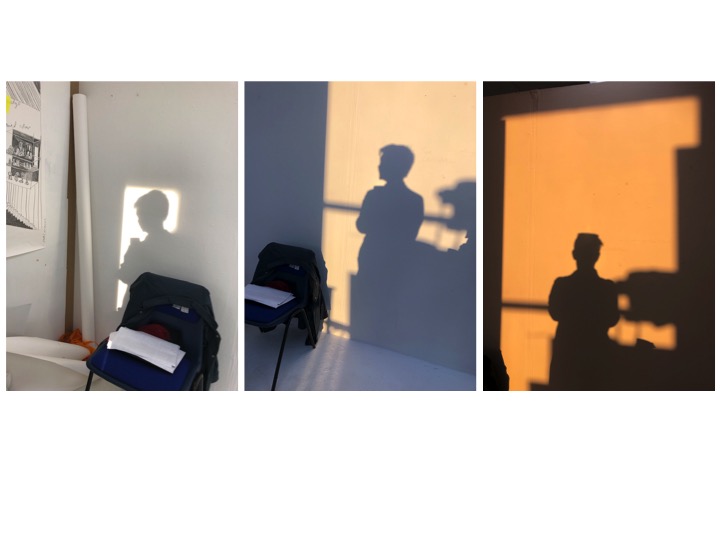
I used the ‘frame within a frame’ device and as I ritually work in groups of three I made this piece with the three images to indicate a passage of time. I used the available light in this and used my iPhone camera, as the SLR camera I had with me was loaded with black and white film.
The contrasting colours, cyan and orange worked as a colour device, the intensity changing with the passage of time. I felt the research I had worked on especially with Gursky’s use of colour in some way reflected on the outcome. I wanted to show a progression from one state to another, a translation, a journey within time and in the my studio space to represent the self. The seeming lion bite enhances the sense of tension and death.
Culverhouse, T (2019)
To evaluate this I really enjoyed the research alongside the practice in this assignment. Taking assignments like this doesn’t come naturally in my practice and Dave Willis is a professional journal photographer so this is his world. I would normally apply for a commission and the concern be for how I want to respond to something so this was a really useful exercise. Reflecting on the research, it pushed me into some familiar but partially unknown territory that is tangential to my practice. I will be looking at the wider cultural response within art along the two years of postgraduate study. Having these excursive opportunities will be very valuable to the growth of my practice.
UPDATE 22ND OCTOBER 2019
I decided to make this triptych into a more than two dimensional object and this is the result later on in the semester on the 22nd October 2019
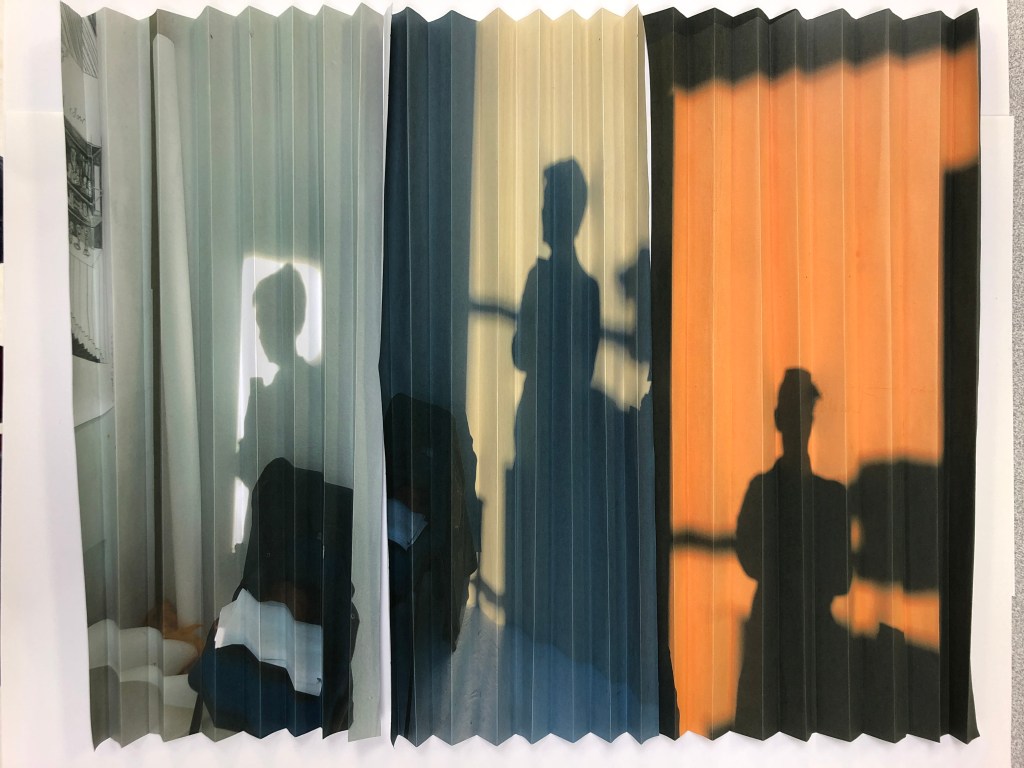
The process of folding these images and distorting the shadows further from the natural pull of the shadow gives the images a greater depth. I had been exploring the fold and how to make the work three dimensional which you will see in other posts.
Fig 1.Friedlander, L (2011). plate 79 of the book under review [Available online]: https://artcritical.com/2012/07/16/lee-friendlander/ Accessed 6/10/2019
Fig 2 Gursky, A (1999). Parliament 1998 [Available online]: https://www.tate.org.uk/art/images/work/P/P11/P11570_10.jpg Accessed 6/10/2019
Fig 3 Mann, S (2006-12). Untitled (Self Portrait) [Available online]: https://uk.phaidon.com/resource/sally-mann-upon-reflection-03.jpg Accessed 6/10/2019
 Tina Culverhouse